Crowley Signature

Left Corner Blue

CAREERS HOME
ADMINISTRATIVE & PROFFESIONAL JOBS
SEAGOING JOBS
VOLUNTARY SELF-IDENTIFICATION FORM


Its No Accident
Dots
Spacer
Spacer
HOME > CAREERS > SEAGOING > 

I'm New to the Industry

Thank you for your interest in working for Crowley and beginning a career in the maritime industry. The maritime industry is growing, providing opportunities for a rewarding career at sea working on deck, in the engine room, or in the steward’s department for Motivated individuals. One of the most difficult tasks an individual has is getting started in this industry. The first step that you can take is learning about the different requirements for various operations and career paths. From there, it is easier to make an educated decision regarding where you wish to go.

Merchant Mariner’s Document

All merchant mariners are required to obtain a Merchant Mariner’s Document from the Coast Guard. Also referred to as a “Z-Card” by many, a Merchant Mariner’s Document (MMD) is similar to a driver’s license: it is a picture ID that lists your basic qualification on the rear and shows that you have approved access to merchant vessels so long as you serve in a capacity appropriate with your qualifications. More information on how to obtain your MMD can be found on the Coast Guard's website: www.uscg.mil/stcw

STCW

For any vessel over a certain size that travels on waters more than 100 miles from shore, all individuals aboard are required to meet requirements set forth by the Standards of Training, Certification, and Watchkeeping, or STCW. The most basic level of STCW is Basic Safety Training (BST) – a four part class that involves personal survival techniques, basic firefighting, elementary first aid, and personal safety and social responsibilities. For higher levels of individuals (such as Mates, Masters, and Engineers) there are greater requirements of training set forth by the STCW. The BST for STCW can be obtained via courses that are offered in any number of locations. An internet search for "STCW Basic Safety Training" may help to find the nearest location and dates these courses are offered.

The large majority of Crowley vessels either go outside of this 100 mile border regularly or they may need to in an emergency, so an STCW endorsement is a company requirement. Some inland/river companies do not require their employees to have an STCW, and after obtaining your MMD you may try to find employment with some of these companies.

Engine vs. Deck – Ratings for Seagoing Individuals

One decision an individual needs to make when they are looking to start a career at sea is whether they want to work on deck, in the wheelhouse, in the engine room, or in the galley. No decision is incorrect, but depends upon what you enjoy and what you are hoping to achieve from your career at sea. Below is a short listing of ratings and a description of what they do on a ship or boat.

  • Ordinary Seaman (OS) – The entry level deck position aboard any vessel. Mainly a training position to learn basic seamanship.
  • Wiper – The entry level engine position.
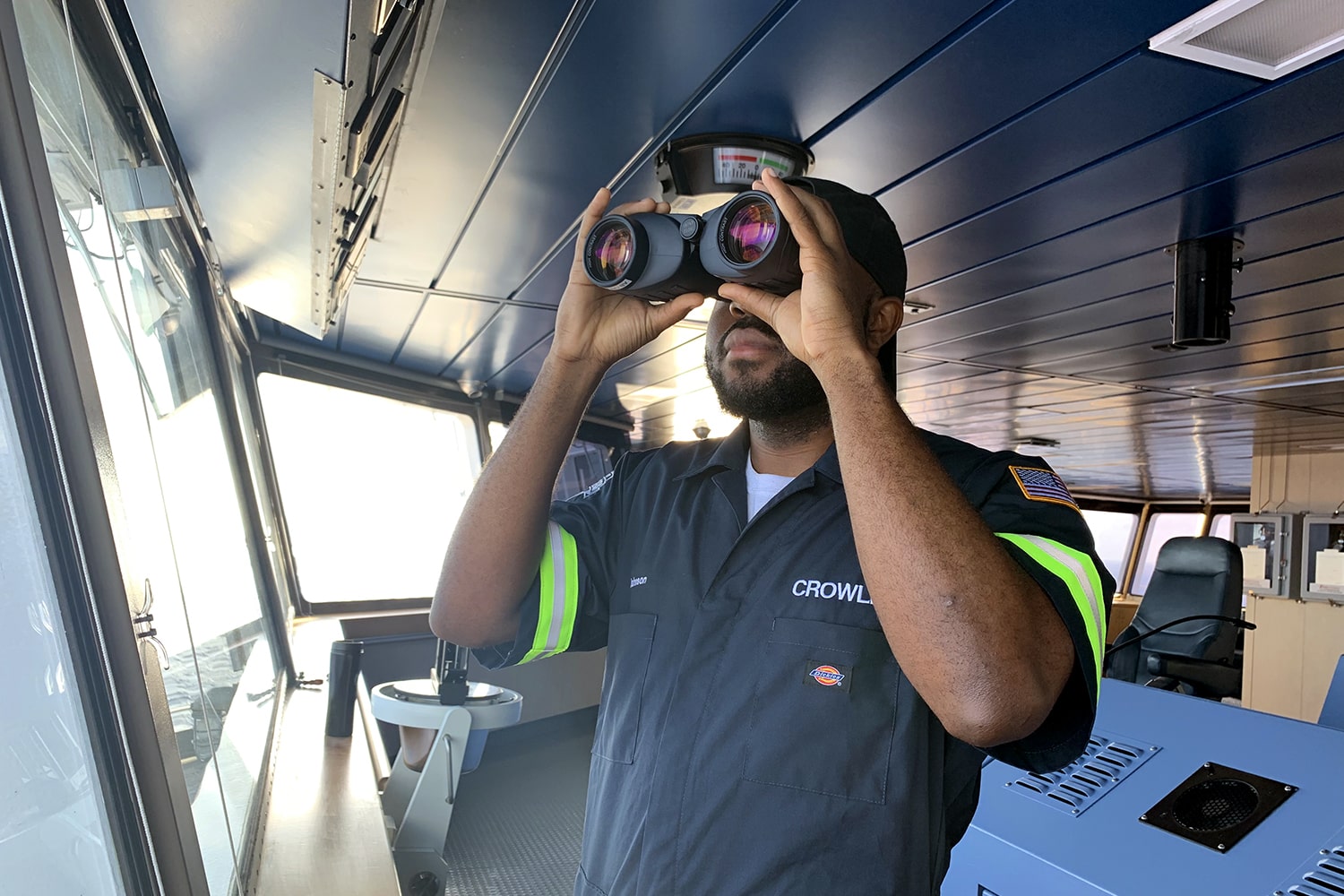
  • Able Bodied Seaman (AB) – A deckhand, responsible for lookout watches and security rounds while underway, an AB also handles lines and assists with all operations on deck including docking/undocking, making and breaking of tows, and deck maintenance.
  • Qualified Man of the Engine Deparment (QMED) – An unlicensed position in the engine room, the responsibilities of a QMED vary greatly from one job to another and often vary depending upon the abilities of the individual. Will assist engineers on ships with making rounds and engine maintenance, a QMED may also be the sole engineer on some towing vessels.
  • Steward Utility, Cook, and Steward – Galley ratings, on ships individuals will work their way up from a utility position, responsible for dishwashing, cleaning of the house, etc. to cook and then to steward who needs to order food and supervise the rest of the galley department. On towing vessels, the cook will often assist as a deckhand if capable.
  • Mate – A deck officer who is responsible for the safe navigation of the vessel. Responsibilities increase from 3rd Mate up to Chief Mate.
  • Engineer – An engine officer who is responsible for the safe operation of the ships propulsion and auxiliary systems. Responsibilities increase from 3rd Assistant Engineer up to First Assistant engineer aboard ships. Aboard tugboats, often there is only one engineer.
  • Chief Engineer – The head of the engine department aboard ships.
  • Master/Captain – The leader of the entire ship/tugboat who holds ultimate responsibility for all of the vessels people and its operations.

Knowing what each position does, you can tailor your decision based upon your career goals. If you like working in a kitchen environment, the stewards department is for you. If you desire to become a Captain or Mate, you would best be suited going into the deck department. If you are a “gearhead” or enjoy the aspects of working in an engine room, you should take an engine route.

Career Development Programs

In recent years, as the need for qualified seamen at all levels has increased, so have the number of available programs that an individual has available to them for reaching their goals. Below is a brief listing of programs that you may want to look into for their suitability to meet your goals:

Seafarer's International Union (SIU) Apprentice Programs - This program will help you go from entry level to Able Seaman or QMED in a year. For more information, visit the SIU’s website: www.seafarers.org/phc

Workboat Academy - A program geared towards the towing and supply boat industry, a motivated individual can go from entry level to Mate in 2 years with intensive on the job (at sea) and classroom training.
www.workboatacademy.com

Shipping Unions – If you only hold an MMD the unions may be able to provide you with advice and opportunities for job placement. For more information, visit these union websites:

  • Inland Boatman’s Union - www.ibu.org
  • Seafarers International Union - www.seafarers.org
  • Master’s, Mate’s, and Pilot’s - www.bridgedeck.com
  • American Maritime Officers - www.amo.org
  • Marine Engineers Beneficiary Association - www.d1meba.org
  • Academies – Four year academies in Maine, Massachusetts, California, Texas, and 2 in New York provide individuals with a Bachelor of Science degree along with a license as Third Mate or Third Assistant Engineer.

  • Maine Maritime Academy - www.mma.edu
  • Massachusetts Maritime Academy - www.maritime.edu
  • California Maritime Academy - http://www.csum.edu/
  • Texas A&M University at Galveston - www.tamug.edu
  • State University of New York Maritime Academy - www.sunymaritime.edu
  • United States Merchant Marine Academy - www.usmma.edu
  • We hope you find this information useful and we wish you luck in your future pursuits.


    Spacer
       Copyright 2003 Crowley Maritime Corporation